Managing content can be overwhelming for small businesses. But in 2026, AI content management systems (CMS) are making it easier by automating tasks like planning, creation, and publishing - all in one platform. These tools save time, reduce costs, and help small teams stay consistent across multiple channels without needing extra staff.
Here are the top 3 AI CMS options for small businesses:
Quick Comparison:
| Platform | Best For | Pricing | Key Limitation |
|---|---|---|---|
| Content Maker Studio | Complete content workflows | $38.80/month | Newer platform, growing ecosystem |
| HubSpot AI (Breeze) | CRM-driven marketing | Premium pricing | Advanced features require higher-tier plans |
| Notion AI | Internal documentation | $10–$18/user/mo | Lacks multi-channel publishing tools |
For small businesses, Content Maker Studio stands out as the most affordable and user-friendly solution for managing content end-to-end.

AI Content Management Systems Comparison for Small Businesses 2026
Managing content with fragmented tools and manual workflows can feel overwhelming. That's where an AI content management system comes in. It's not just a place to store files or publish blog posts - it’s an all-in-one platform that streamlines content planning, creation, publishing, and tracking [4][11]. Think of it as the difference between a simple filing cabinet and a smart assistant that actively helps you create, organize, and optimize your content.
While traditional CMS platforms like WordPress serve as passive tools where you manually input, format, and schedule content, AI-powered systems for small businesses act as proactive assistants [2]. They can draft social media posts in your brand’s tone, repurpose blog content for social channels, provide real-time SEO recommendations, and analyze performance across platforms [4][3]. Instead of juggling multiple tools for writing, design, scheduling, and analytics, these systems handle the entire content process in one place.
"AI levels the playing field. It allows small and medium-sized enterprises (SMEs) to access the same fast customer service, instant data analysis, and creative opportunities as large corporations - at a significantly lower cost." - Ken McMahon, Head of Customer Success, Nextiva [3]
This shift is transformative for small businesses. 92% of businesses have already incorporated AI into their customer service processes [3], and the benefits are clear: employees save an average of 6.2 hours per week on administrative tasks thanks to AI [4]. That’s time that can be redirected toward growing the business and engaging with customers. AI content management systems work as an always-available resource [3], offering the capabilities of a full marketing team without the added payroll costs.
For small teams, these systems eliminate the need to choose between consistency and sanity. By automating repetitive tasks - like drafting, formatting, scheduling, and optimizing - business owners can focus on scaling their operations and delivering value to their customers. Up next, we’ll dive into the top solutions that bring these benefits to life, starting with Content Maker Studio.

Content Maker Studio offers a comprehensive solution tailored for small businesses, combining key content creation processes into one efficient system. It integrates planning, writing, design, and scheduling, enabling businesses to produce consistent, professional-quality content without the added cost or hassle of multiple tools. By consolidating these essential tasks, it helps small businesses thrive without needing to expand their team.
At the core of Content Maker Studio is its Content Calendar, a tool that simplifies campaign planning with a drag-and-drop interface. Whether you're working on blogs, social media posts, Google ads, or email newsletters, the calendar keeps everything organized in one place [9]. Powered by GPT-5, the built-in AI assistant takes care of brainstorming ideas, drafting content in your brand's tone, and turning a single piece of content into various optimized formats. This automation ensures smooth multi-channel publishing, making it easier to execute your marketing strategy.
Content Maker Studio uses Generative AI to transform a single long-form article into multiple formats, like video scripts, infographics, or promotional materials tailored to different platforms and audiences. It also supports A/B testing and market-specific variations, allowing businesses to fine-tune their messaging. With its campaign remixing feature, a single product description can be repurposed into press releases, social posts, and more - saving time and effort. This flexibility, combined with its intuitive design, makes it a great fit for small businesses looking to maximize their reach.
For just $38.80 per month, Content Maker Studio provides access to 12 AI assistants that handle everything from content planning and creation to SEO, audience research, and performance tracking. This all-in-one approach eliminates the need for multiple subscriptions, offering advanced marketing capabilities at a fraction of the cost of hiring a dedicated team. It’s a smart investment for businesses focused on improving efficiency and boosting revenue.
Content Maker Studio is built with simplicity in mind, featuring a no-code, drag-and-drop interface [5][12]. You don’t need to know APIs, coding, or complicated integrations to use it. Over time, the AI assistants adapt to your brand’s voice, ensuring consistent and personalized content. Automated compliance checks help you meet platform guidelines, and direct publishing to major social media platforms makes scheduling and distribution a breeze. It’s a tool designed to empower business owners, regardless of their technical expertise.
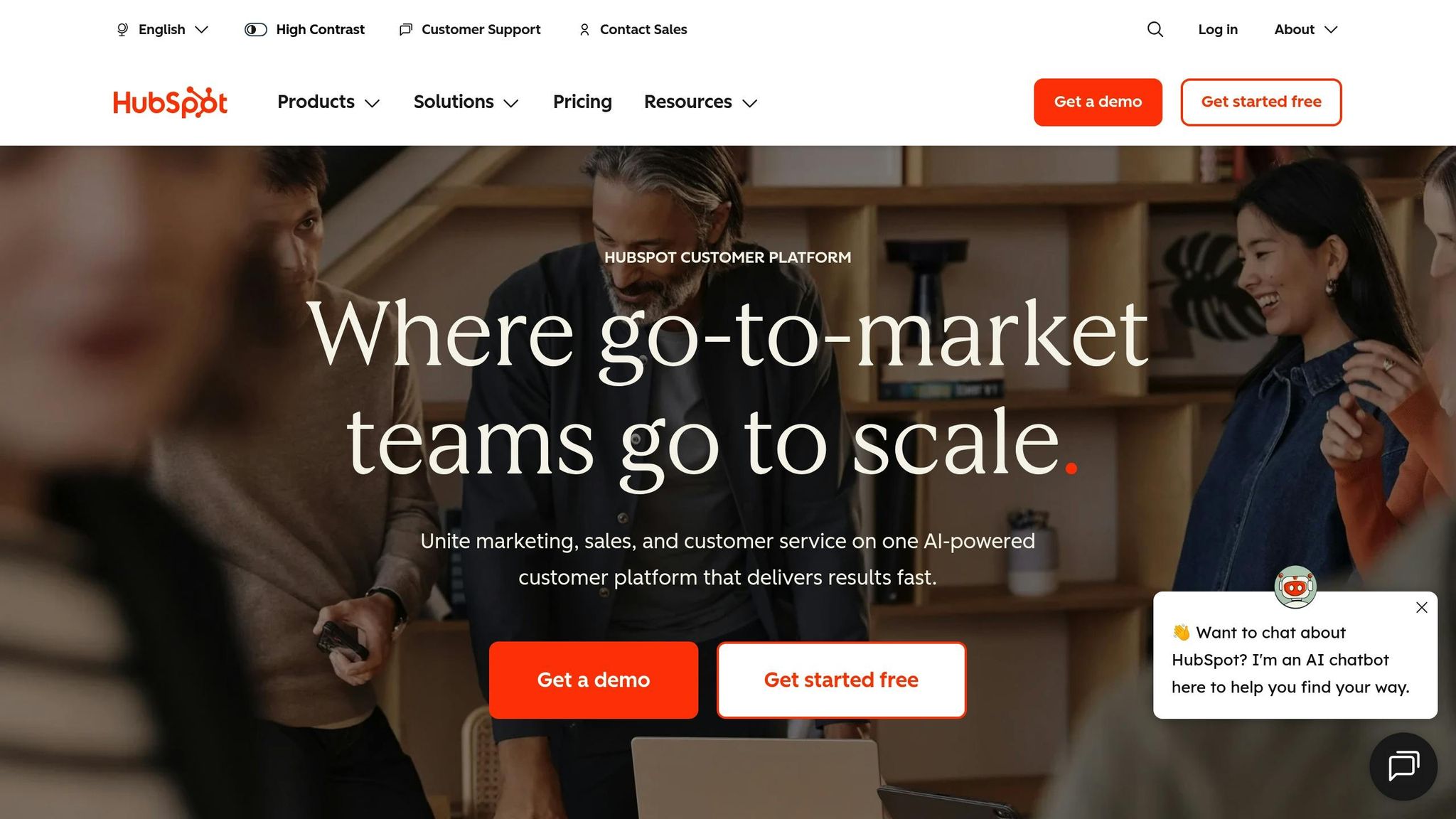
For small businesses looking for a seamless way to manage content workflows, HubSpot AI offers a smart, integrated solution. Known as Breeze, this tool brings AI into HubSpot's marketing, sales, and service hubs. It allows teams to handle content workflows without juggling multiple tools. Breeze is built around three main features: Breeze Assistant (an AI companion connected to CRM), Breeze Agents (AI-powered helpers that automate tasks), and Breeze Studio (a no-code platform to customize AI assistants)[6]. Together, these tools simplify content planning and execution.
Breeze Agents take care of content workflows from start to finish. The Content Marketing Agent and Social Media Agent handle tasks like brainstorming, drafting, and scheduling, while the Breeze Assistant leverages CRM data to create tailored content strategies[6]. For example, in August 2025, Agicap reported saving 750 hours per week and boosting deal velocity by 20% with HubSpot Breeze[6]. Additionally, the platform includes an AI Blog Writer for generating posts from simple prompts and a Content Remix tool that repurposes successful content for various channels[6].
HubSpot AI supports content creation across multiple formats, including blogs, marketing emails, sales outreach, social media posts, and single-page websites[6]. Sandler, for instance, saw a 25% increase in engagement and generated four times more sales leads in August 2025 using Breeze to deliver personalized experiences[6]. Unlike standalone AI tools, HubSpot integrates CRM data to ensure repurposed content stays true to the brand's voice and aligns with customer needs[6].
HubSpot offers a free tier that includes Breeze Assistant and select AI features, making it easy for small businesses to try the platform before committing[6]. However, full access to Breeze Agents and advanced customization tools requires a premium subscription. This makes it a better fit for small and medium-sized businesses with funding and an existing HubSpot CRM setup. While its advanced features deliver strong results, the platform remains designed with user-friendliness in mind[6].
With its no-code interface and straightforward prompts, HubSpot AI is designed to be accessible, even for users without technical expertise[6]. Breeze Studio allows businesses to customize AI agents without writing a single line of code. Tools like the AI Blog Writer and Website Generator operate through simple prompts, making them easy to use[6]. For instance, Kaplan reduced customer service response times by 30% in August 2025 by incorporating Breeze into their operations[6]. The real advantage of HubSpot AI lies in its unified system, making it an excellent choice for businesses already invested in the HubSpot ecosystem.
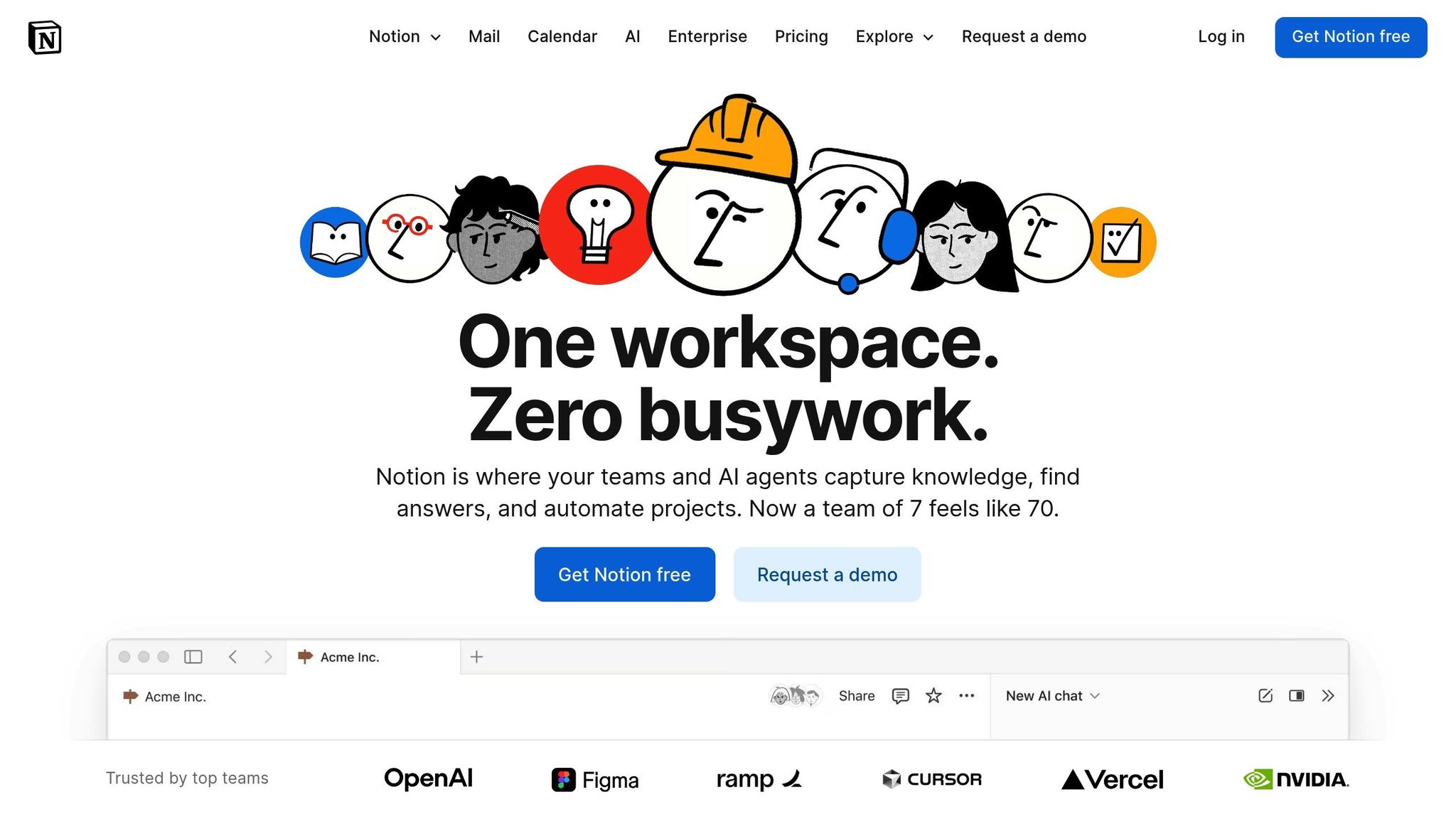
Building on the trend of integrated content tools like HubSpot AI, Notion AI takes a different path by focusing on internal documentation and team planning.
Notion AI acts as a centralized workspace designed to streamline internal processes for small businesses. With a user base exceeding 100 million worldwide and earning G2's title of the #1 knowledge base for three straight years, Notion has grown from a simple note-taking app into a robust platform for planning and documentation [10].
One standout feature of Notion AI is its Research Mode, which transforms raw ideas into polished, structured documents by leveraging both internal data and web research [13]. It also employs custom AI agents to automate tasks like summarizing meeting action items and updating database records [13][3]. Many teams have reported that using Notion has helped them cut down project timelines by up to three times [10].
Another time-saving feature is the AI-powered enterprise search, which scans Notion docs, PDFs, and even integrated apps like Slack and Google Drive. This makes finding information faster and more efficient [13][3].
While Notion AI shines in organizing and drafting content, it falls short when it comes to guided multi-channel publishing [2][1]. The platform can repurpose material - such as converting meeting transcripts into social media posts or translating documents into various languages - but it doesn't offer the tools for seamless content distribution across multiple channels [10][13].
"It's the slickest, most practical implementation of generative AI for the text I've used to date" [13]
This quote highlights Notion AI's strength in documentation rather than its capabilities in content execution.
Notion AI's pricing is accessible for small businesses. The Plus Plan costs $10 per user/month, while the Business Plan is priced at $18 per user/month, both offering advanced AI functionalities [3]. There’s also a free version available for basic use, making it easy for businesses to try before committing [10]. With 62% of Fortune 100 companies and over half of Y Combinator companies relying on Notion, it’s clear that the platform has established itself as a trusted tool for managing knowledge [10]. However, users must create their own workflows, as the platform doesn’t come with pre-built systems for consistent multi-channel content execution.
Notion AI is particularly well-suited for teams that prioritize internal organization and process automation [10]. Features like the "Wiki cleanup" tool help ensure documentation stays current by flagging outdated pages, while its Q&A capability makes searching across fragmented tools effortless [3].
For small businesses focused on refining internal processes rather than external content distribution, Notion AI is a strong choice. However, its lack of comprehensive publishing and performance tracking tools sets it apart from all-in-one solutions, making it a specialized tool for specific needs in the small business landscape.
When choosing an AI content management system, small businesses need to weigh cost, ease of use, and how well the platform fits into their workflow. Below is a breakdown of three key players in 2026: Content Maker Studio, HubSpot AI (Breeze), and Notion AI.
| Platform | Best For | Core Strength | Limitations | Pricing | Ideal Business |
|---|---|---|---|---|---|
| Content Maker Studio | Complete content operations | 12 AI assistants working as a unified team - planning, creating, optimizing, and publishing across channels | Newer platform with a growing ecosystem | $38.80/month | Small businesses and solopreneurs needing an all-in-one content system |
| HubSpot AI (Breeze) | CRM-driven marketing | Fully integrated with marketing, sales, and service hubs using real CRM data; Breeze Agents automate content marketing and sales prospecting | Advanced AI features limited to premium editions; some tools, like Breeze Studio, are still in Beta | Premium pricing | Funded startups focused on growth and customer acquisition |
| Notion AI | Internal documentation | Centralized workspace for knowledge management; transforms unstructured notes into professional documents | Lacks guided multi-channel publishing and performance tracking | $10–$18/user/month | Process-driven teams prioritizing internal organization over external content distribution |
Each platform shines in its own way, but Content Maker Studio stands out for small businesses thanks to its unified approach. By consolidating all content operations into one tool, it eliminates the need for multiple platforms, reducing complexity and cost. While HubSpot AI is a strong contender with its seamless CRM integration, its premium pricing and advanced features cater more to companies with dedicated marketing teams. On the other hand, Notion AI is excellent for internal organization but falls short in tools for executing multi-channel content strategies.
For small businesses, the priorities are clear: affordability, simplicity, and a solution that covers all content needs. Content Maker Studio strikes the perfect balance, making it the go-to choice for businesses looking to streamline their content strategy without breaking the bank. These distinctions help clarify which platform might be the best fit for your goals, setting the stage for more detailed insights in the upcoming sections.
Let's take a closer look at how AI content management systems stack up against traditional CMS platforms like WordPress and Webflow.
Traditional CMS platforms primarily function as storage and publishing tools. They help you organize files, draft pages, and publish content, but they don’t manage the entire content lifecycle. Tasks like writing, SEO optimization, and adapting content for different channels still require manual effort.
AI content management systems, on the other hand, go beyond basic storage and publishing. They automate workflows and execution, taking care of research, drafting, tagging, optimization, and even distributing content across multiple channels. As Amanda Lee, a Content Management Specialist at CrafterCMS, puts it:
"An AI CMS is more than just a traditional CMS with a few AI features, it's a next-generation platform that integrates AI capabilities to support content creation, optimization, and distribution." [7]
One key difference lies in how metadata, keyword research, and SEO audits are handled. Traditional systems rely heavily on manual input for these tasks. In contrast, AI platforms automate them - accurately tagging content, identifying gaps in topics, and even suggesting internal links based on your site’s structure. For instance, while WordPress might need plugins to handle basic optimization, AI systems come equipped with built-in tools that leverage vector databases and natural language processing to understand context and intent [7][14]. This level of automation is what truly sets AI systems apart.
For small businesses, this efficiency can mean substantial time and cost savings. Traditional platforms assume you have the resources to manage content manually. AI systems, however, act like 24/7 assistants, handling repetitive tasks so you can focus on strategic decisions [3].
The CMS market reflects this shift. It’s projected to grow from $36 billion in 2018 to $123.5 billion by 2026 [8]. This surge underscores the growing demand for platforms that don’t just store content but actively create, optimize, and distribute it - making AI content management systems a key driver of modern content strategies.
To find the best AI content management system for your business, start by identifying repetitive tasks where AI could save time and effort. This focus on streamlining operations will help you zero in on the platform that aligns with your specific needs.
Content Maker Studio is a top choice for most small businesses because it simplifies the entire content workflow. At $38.80 per month, it combines planning, creation, optimization, and publishing into one seamless system [1]. Unlike platforms that merely offer AI suggestions or limited drafting capabilities, Content Maker Studio functions more like an AI-powered marketing team. It delivers the structure and results of a full team - without the need to hire additional staff.
For businesses already using a CRM to lead their operations, HubSpot AI (Breeze) is a logical fit. It integrates marketing, sales, and service teams into a single platform [6]. However, its complexity and higher costs make it better suited for companies with sufficient funding and dedicated marketing departments.
On the other hand, Notion AI shines when it comes to organizing internal documents and turning meeting notes into structured knowledge [2]. That said, it lacks the tools for guided content execution and publishing, which small businesses often rely on to maintain a consistent external presence.
For small businesses without an in-house marketing team, Content Maker Studio stands out. It’s designed for non-technical owners who need to maintain consistency across channels, manage content independently, and transform that content into visibility and revenue - all without the expense of hiring specialists. This makes it an ideal solution for staying efficient and competitive.
By 2026, content creation has become a must-have for small businesses aiming to stay competitive. The key to thriving lies in maintaining visibility and consistency across multiple channels - without overwhelming your team. This is where AI content management systems step in, automating tasks, integrating tools, and offering team-wide benefits at a fraction of the cost.
Industry experts stress the importance of this shift:
"AI isn't optional anymore. It's the advantage that decides who grows in 2026." - Credofy [5]
AI-powered platforms simplify content workflows, helping small businesses achieve measurable improvements in efficiency and revenue. This streamlined approach not only saves time but also drives better performance and growth.
Take Content Maker Studio as an example. For just $38.80 per month, it offers an all-in-one solution that plans, creates, optimizes, and publishes content across channels. Designed with non-technical business owners in mind, it delivers professional-quality results without the need for a dedicated marketing team.
For small businesses looking to turn content into visibility, leads, and revenue - without the hassle or cost of enterprise-level tools - Content Maker Studio stands out as the ideal choice.
AI content management systems (AI CMS) take content management to a whole new level by weaving artificial intelligence into every step of the process. Unlike traditional platforms like WordPress or Drupal, which mainly handle storing and publishing content, AI CMS platforms bring automation to tasks like content planning, SEO optimization, and performance monitoring.
With an AI CMS, you can easily brainstorm topic ideas, transform content into various formats, and ensure your brand voice stays consistent - all with minimal manual effort. Essentially, these systems function like a virtual content team, simplifying workflows and cutting down the need for multiple tools. This makes them especially appealing for small businesses aiming to save both time and resources.
AI content management systems (CMS) offer small businesses an all-in-one solution to streamline and automate tasks like content creation, planning, publishing, and performance tracking. These platforms use AI to generate and fine-tune content such as blog posts, social media updates, and email campaigns. They can even transform a single idea into multiple formats, saving time and cutting down the need for a full marketing team.
By storing all content in one centralized library, AI CMS platforms help businesses maintain consistent branding and a cohesive voice across all channels. They also simplify publishing schedules and eliminate the reliance on multiple tools like spreadsheets, schedulers, and design software. This not only reduces costs but also enhances efficiency. For small businesses, the result is faster workflows, improved online visibility, and the ability to generate more leads - all without breaking the bank.
Content Maker Studio is the go-to platform for small businesses in 2026, offering an all-in-one, AI-powered solution designed specifically for the needs of lean teams. Instead of juggling multiple tools or relying on freelancers, this platform streamlines everything - content planning, creation, publishing, and analytics - into one easy-to-use system.
Key features like guided weekly planning, multi-channel management, and a repurposing studio ensure businesses can stay consistent and organized, even without a tech-savvy team. Its budget-friendly pricing and focus on driving real results - like boosting visibility, generating leads, and increasing revenue - make it a smart choice for small businesses looking to thrive in a competitive landscape.