AI-driven content monitoring automates data analysis, tracks trends, and identifies audience sentiment instantly. This helps businesses respond faster to social media queries, adjust campaigns in real time, and spot emerging opportunities or risks. Key technologies include:
Examples like the Associated Press and Netflix show how AI cuts manual effort and improves decision-making. Tools like Content Maker Studio make these capabilities accessible to small businesses, offering real-time insights, sentiment tracking, and performance forecasting. AI simplifies content management, allowing businesses to focus on strategy while staying ahead in a fast-paced digital environment.

Three AI Technologies That Power Real-Time Content Monitoring
Three AI technologies are reshaping how content is monitored in real time. They make the process faster, smarter, and more actionable.
Machine learning (ML) stands out for its ability to detect anomalies, like sudden spikes in brand mentions or unexpected shifts in online discussions. These could signal anything from a brewing PR crisis to a viral opportunity [1][7]. Unlike older systems that rely on periodic reports, ML scans data feeds continuously, picking up subtle trends and triggering alerts - even during off-hours [6]. Companies using event-driven tools like Apache Kafka or Flink can stream social media data in real time, flagging harmful posts before they spiral out of control [3]. Weighted scoring systems further help teams prioritize content for review [10].
"A single viral post has the ability to significantly damage a brand's reputation and cause its share price to tumble. To mitigate this risk, PR teams need to have visibility of potentially damaging posts as they happen." - Confluent [10]
This proactive approach also benefits small businesses. They can monitor competitor activity and track influencer interactions to stay ahead [6][7].
Next, natural language processing takes content monitoring to the next level by interpreting audience sentiment.
Natural language processing (NLP) allows machines to understand emotional tones, sarcasm, and even implied meanings, going far beyond basic keyword detection. With tools like aspect-based sentiment analysis, businesses can gain detailed insights - for instance, identifying excitement about a product's design but dissatisfaction with its durability [11]. NLP acts as an early warning system; a sharp sentiment drop (like a 10% decline in a day) can signal an upcoming backlash [11]. It also filters out irrelevant chatter while capturing conversations where a brand isn’t directly mentioned, offering a more complete picture of public opinion [9].
The results can be game-changing. Businesses using real-time sentiment analysis report up to a 233% increase in ROI [11]. Advanced models like BERT, Claude, and GPT-4 excel at understanding context, from regional slang to emojis [11].
Katie DuPre of the Atlanta Hawks shared an example of how this works:
"A lot of internal stakeholders love seeing the Topic Insights Word Cloud and Sentiment Summary. When we launched the Martin Luther King Jr. Nike City Edition jersey earlier last season, it was met with 99% positive sentiment." - Katie DuPre, Atlanta Hawks [11]
For effective monitoring, businesses should guide AI with relevant keywords - think brand names, hashtags, or competitors - while letting the NLP engine handle sentiment classification. This approach can also identify competitor weaknesses by analyzing audience feedback [11].
Finally, predictive analytics helps businesses look ahead by forecasting content performance.
Predictive analytics uses historical data to estimate how content will perform. Early indicators - like first-hour watch time, click-through rates, or initial shares - can help businesses predict long-term trends. This allows for quick adjustments to budgets and strategies, often on a daily or weekly basis instead of waiting for monthly reports [12].
The technology also identifies "predictive decay", which flags content at risk of losing its effectiveness. AI systems monitoring traffic and click-through rates can alert teams before a page's authority drops [4].
"Traditional reporting tells them what happened. It rarely tells them what will happen if they act differently tomorrow." - Nikhil John, InCyan [12]
Time-series models can even pinpoint the best times to post or the ideal release schedule for different audiences [12]. Prescriptive analytics takes it further by recommending specific actions, like reallocating budgets or testing new thumbnails. For small businesses, setting clear triggers - such as refreshing content when organic traffic is projected to drop by 20% - ensures these strategies are scalable and effective [4].
| AI Technology | Role in Content Monitoring | Business Benefit |
|---|---|---|
| Machine Learning | Detects unusual patterns and anomalies in real time | Provides early alerts for trends or crises |
| Natural Language Processing (NLP) | Analyzes tone, sarcasm, and emotional cues | Offers deeper insights into audience sentiment |
| Predictive Analytics | Forecasts content performance using historical data | Enables proactive adjustments to strategies |
These examples highlight how AI is reshaping real-time content monitoring by providing instant, actionable insights. Two prominent organizations, Associated Press (AP) and Netflix, demonstrate how AI has shifted their monitoring approaches from reactive to proactive.

The Associated Press processes an enormous amount of footage annually, producing around 150,000 edited items [14]. To manage this workload, AP turned to AI-driven systems, which have revolutionized their operations.
In 2024, AP collaborated with Limecraft, Vidrovr, and Trint to introduce automatic shot-listing. This system automates tasks like scene descriptions and facial recognition across their video library, benefiting hundreds of broadcast and digital partners. According to Sandy McIntyre, Vice President of News at AP, this initiative saved countless hours of manual work. Tasks that once took an entire day are now completed in seconds.
"All news companies spend an enormous amount of time on manual work. Given where AI is today, we felt like we could use that to tackle our problem." - Sandy McIntyre, Vice President News, Associated Press [14]
In December 2025, AP launched AP Verify, an AI-powered dashboard that combines geolocation, object detection, and transcription to authenticate online content in real time [13]. This tool has already proven indispensable. For instance, AP's global teams used it to verify a meteor sighting in South Carolina by tracing video frames back to their original source. Similarly, it debunked a viral video falsely claiming to show soccer match violence in Israel, which actually occurred in Greece [13].
AP's Merlin search tool adds another layer of efficiency by identifying elements within photos and videos without relying on metadata. The AI models are trained to detect the top 300 names and specific actions, such as a political leader disembarking from a plane or delivering a speech - scenarios that frequently appear in global news [14]. To ensure transcription accuracy meets professional standards, AP continues to refine its AI models to achieve a word error rate below 2% [14].
"AP Verify equips journalists with the essential tools they need to assess online content quickly and accurately all in one place – whether it's identifying the source of a photo, analyzing video or vetting text." - Gianluca D'Aniello, Senior Vice President and Chief Technology Officer, The Associated Press [13]
While AP focuses on news verification, Netflix applies AI to enhance user engagement and streamline content production.

Netflix, a leader in streaming, faces unique challenges due to the sheer scale of its content. A single hour of video can generate over 80,000 frames for machine learning analysis [15]. To handle this, Netflix developed its Media Understanding Platform (MUP), which integrates machine learning into studio tools for real-time search and discovery.
In March 2023, Netflix introduced the Media Search Platform (MSP) to assist studio editors in locating specific visual elements for marketing materials. For example, editors can now instantly find all shots of a dining room across 10 episodes - a task that previously required one or two people to spend an entire day [15].
Netflix also uses AI to monitor user behavior, delivering hyper-personalized recommendations that keep viewers engaged. Additionally, the company employs generative AI for localization, automating subtitles and dubbing. This not only reduces costs but also ensures content is accessible to a global audience [15].
Both AP and Netflix demonstrate how AI can streamline workflows and enable proactive decision-making, redefining the landscape of real-time content monitoring.
| Organization | AI Application | Time Saved | Business Impact |
|---|---|---|---|
| Associated Press | Automatic shot-listing and facial recognition | Hundreds of hours of manual work | Faster distribution to broadcast and digital partners |
| Associated Press | AP Verify dashboard | Reduced verification from hours to seconds | Real-time authentication of viral content |
| Netflix | Media Search Platform (MSP) | Reduced search from 1–2 days to seconds | Faster creation of trailers and marketing assets |
| Netflix | Pre-computed AI data for discovery | Zero delay in search results | Improved user experience and retention |
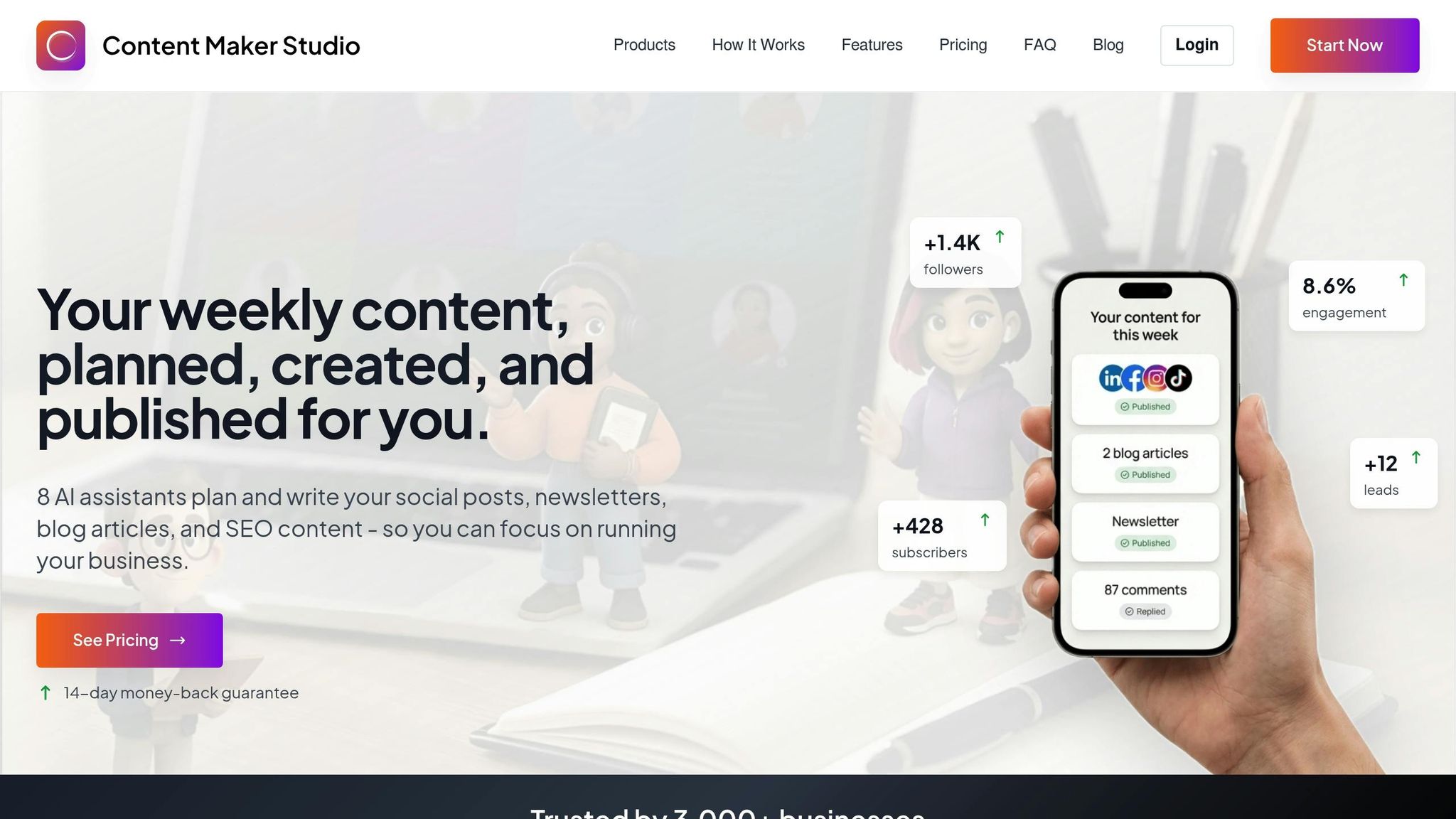
Content Maker Studio brings advanced AI tools to small businesses, offering them the ability to monitor and analyze their content in real time. While large organizations often rely on custom-built AI systems, smaller businesses need tools that are both accessible and effective. Content Maker Studio delivers on this need with 12 AI-powered assistants that automate data collection and analysis, providing real-time insights. This setup creates a bridge between enterprise-level capabilities and tools that smaller teams can easily use.
The platform simplifies performance tracking by automatically generating branded newsletters and reports. These reports include AI-generated summaries and interactive charts, making it easier to share updates with stakeholders. Its sentiment analysis tools, powered by natural language processing, classify brand mentions into positive, negative, or neutral categories. According to research, using real-time sentiment dashboards can reduce negative user sentiment by 34% in just six months [17]. Additionally, users can explore the "AI Insights" tab under Social Analytics to receive automated recommendations tailored to their content strategy.
Content Maker Studio goes beyond reporting by actively enhancing content strategies. The platform identifies trending topics, popular hashtags, and engagement patterns, ensuring users stay ahead of market changes. Its forecasting feature predicts how well content will resonate before it’s even published. AI assistants also help craft optimized hashtags and captions that align with a brand’s voice. For underperforming content, the system highlights areas for improvement and suggests actionable steps to boost reach and engagement. Smart Scheduling takes it a step further by analyzing audience activity to recommend the best posting times, enabling businesses to respond to trends up to five times faster than their competitors [17].
The platform integrates seamlessly with major social media platforms, including Facebook, Instagram, LinkedIn, Pinterest, TikTok, and YouTube. It consolidates key metrics into a single dashboard, making it easier to manage social media performance. The unified social box ensures that no audience interaction goes unnoticed, streamlining communication efforts. Businesses can also set up alerts for sudden spikes in mentions or negative sentiment, helping them address potential PR issues before they escalate. For those interested in trying the platform, a 14-day free trial is available - no credit card required [16].
AI-powered monitoring tools are stepping up their game, moving beyond identifying issues to predicting and preventing them before they even happen. These tools now feature autonomous agents capable of handling entire workflows—from planning and writing to optimizing content—by spotting performance dips, drafting updates, and routing them for approval. A striking statistic: over 70% of pages referenced by AI models have been updated within the last year, making regular content updates a must for staying visible online [4]. This shift paves the way for agentic models that can handle full content refresh cycles on their own.
Agentic AI models are changing the way businesses keep tabs on their content. Unlike older tools that simply generate periodic reports, these advanced programs are always on, directly integrated with platforms like Google Search Console. They continuously analyze patterns to predict potential ranking drops [4]. For instance, if organic traffic falls by 20% or click-through rates dip below a set threshold, these agents spring into action. They draft updates, refresh outdated stats, and fine-tune metadata to ensure the content remains authoritative [4].
Using Multi-Armed Bandit algorithms, these systems test and tweak elements like headlines, calls-to-action, and metadata in real time. This approach eliminates delays between identifying a problem and fixing it [21]. In tests, proactive agents with context-awareness delivered up to 8.5% greater accuracy in predicting service needs compared to reactive models [20]. They can even roll out updates across an entire site at once, ensuring details like pricing or feature descriptions are consistent everywhere [4].
While these agentic systems handle the heavy lifting, large language models take things further by sharpening semantic accuracy and enabling faster responses.
Large language models are reshaping content monitoring by helping brands track their visibility in AI-generated outputs across platforms like ChatGPT, Claude, and Perplexity. Interestingly, 85% of brand mentions in AI search now come from third-party pages rather than the brand's own domain. Even more concerning, only 30% of brands maintain visibility from one AI search result to the next [4]. This highlights the growing need for Answer Engine Optimization to keep brands consistently visible.
LLMs also enable advanced fixes through Retrieval-Augmented Generation (RAG) technology. For example, a Class-RAG system using an external library boosted the Area Under the Precision-Recall Curve (AUPRC) by 245% for out-of-distribution datasets compared to older models [18]. Modern platforms demand lightning-fast classification speeds - under 50 milliseconds. TikTok's system, for instance, achieved 99.2% automated accuracy when removing 27.8 million harmful items in 2025 [5][19].
These advancements empower businesses to act on real-time insights, keeping their content optimized and impactful in an ever-changing digital environment.
AI-driven content monitoring brings efficiency, enhances quality, and increases engagement. By automating data collection and analysis, AI eliminates the manual bottlenecks that often slow down decision-making, allowing you to focus on higher-level strategic tasks [2][1]. These systems can process billions of messages across various platforms simultaneously - something that would be impossible for any human team to achieve [5][24].
AI also elevates content quality by using natural language processing to grasp context, emotion, and subtle nuances [25]. Currently, over 50% of businesses use AI across multiple functions, with sales and marketing leading the way. This technology helps reduce errors and inconsistencies that are common in manual processes, ensuring decisions are backed by reliable, high-quality data [25][2].
When it comes to engagement, AI plays a key role in creating safer, more personalized user experiences. By quickly removing harmful content, it fosters trust and keeps users engaged on your platform [26][5]. In fact, nearly 30% of users aged 18 to 34 express a desire for stricter content moderation [7]. AI enforces community standards consistently, avoiding the bias and fatigue often associated with manual moderation [8]. Additionally, real-time sentiment analysis allows you to adapt content to your audience's mood, strengthening the connection between your brand and its consumers [2][3].
This shift from manual monitoring to automated insights highlights the transformative power of AI discussed throughout this article. These advancements open up practical opportunities for small businesses to thrive.
Small businesses don’t need massive budgets or technical expertise to benefit from AI monitoring. Start by exploring platforms with strong API capabilities that integrate smoothly with your current CRM and CMS systems [2]. Many tools provide free trials or starter plans, giving you the chance to test features before committing financially.
Consider a hybrid approach: let AI handle high-volume tasks while you focus on strategic decision-making [24]. Use automated workflows with rule builders to address recurring issues, like flagging critical violations automatically, so you’re not constantly putting out fires [23]. Monitor user behavior over time to apply appropriate scrutiny to new accounts, while offering more freedom to trusted community members [22]. Finally, rely on AI-generated insights instead of gut instincts to guide your content strategy - whether that means staying the course or making adjustments [25][2].
AI systems should prioritize data sources that deliver up-to-date and meaningful information. Some of the most critical sources include social media platforms for monitoring trends and public sentiment, news outlets for staying informed with real-time developments, and user-generated content (UGC) platforms to detect harmful or inappropriate material. These channels provide a window into public opinion and potential risks, helping organizations react swiftly, maintain brand safety, and uphold compliance standards.
AI sentiment analysis has the potential to reach over 95% accuracy in identifying sarcasm when leveraging advanced algorithms capable of understanding context and irony. That said, sarcasm poses a unique challenge - it’s subtle, varied, and often heavily reliant on tone or context, making it tricky for even the most sophisticated models to interpret consistently.
Set up alerts for negative sentiment changes, sharp increases in mentions, and unexpected shifts from typical mention trends. These alerts act as early warning signs, helping you spot potential PR issues quickly and take action to address them before they escalate.