When businesses expand globally, keeping a consistent brand voice is critical. It builds trust and ensures customers recognize your brand, no matter the language. But achieving this consistency is challenging due to cultural differences, the risk of translation errors, and operational hurdles like scaling content production.
AI-powered tools are transforming this process. Platforms like Content Maker Studio combine speed and precision to help businesses maintain their tone, style, and messaging across languages. Unlike traditional translation, which is slow and costly, or generic AI engines, which often miss nuances, specialized platforms balance efficiency with accuracy. Here's a quick breakdown:
For companies aiming to grow globally, using AI tools like Content Maker Studio can save time, reduce costs, and maintain a strong, unified brand identity across markets.

Comparison of Translation Methods: Traditional vs AI vs Content Maker Studio
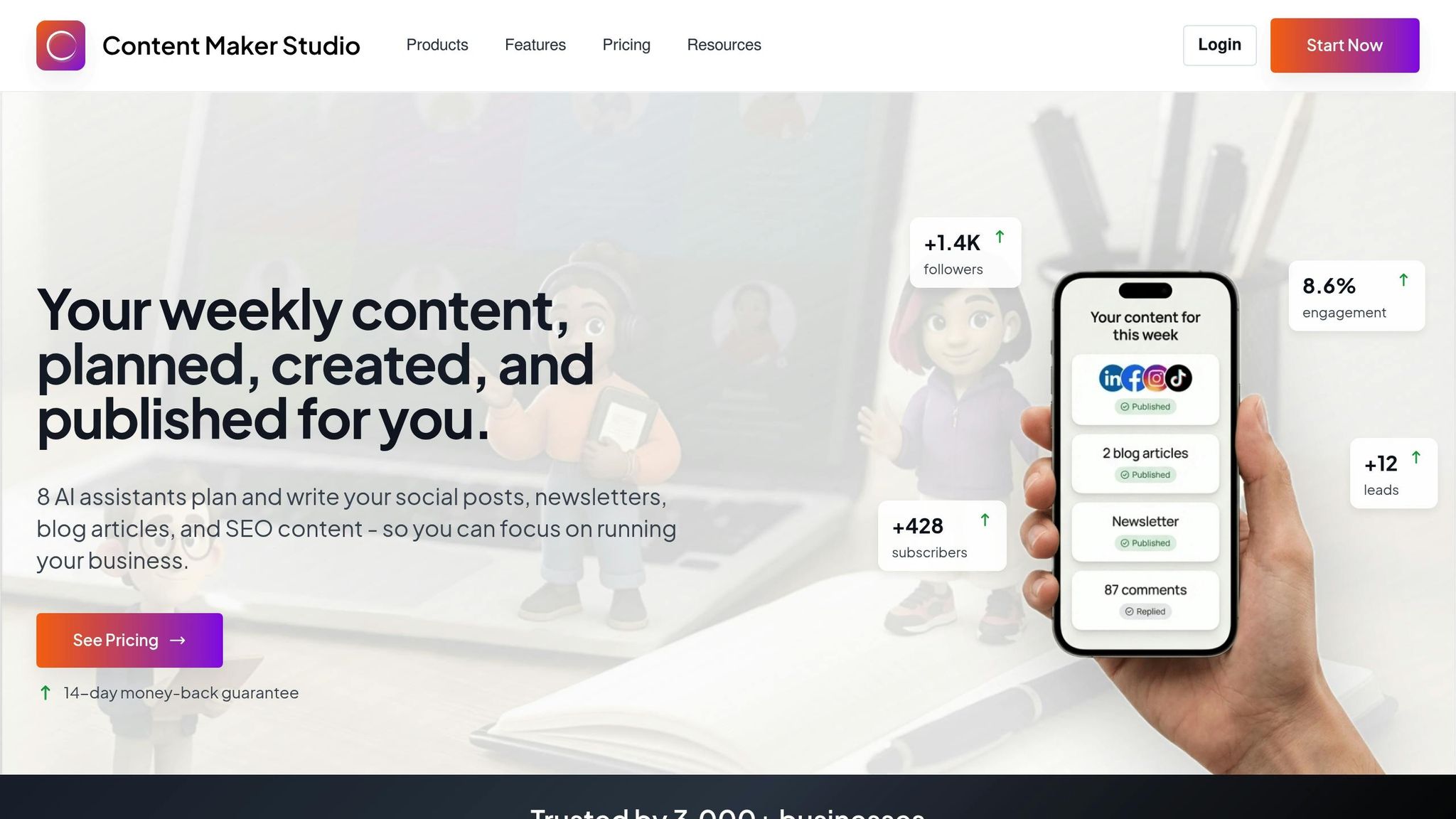
Content Maker Studio goes beyond simple translations. Its AI-powered tools dive into cultural nuances to make sure your message connects with local audiences. For instance, when a cycling brand expanded into Switzerland, the platform tailored its messaging to match local consumer preferences. Meanwhile, in China, it reworked the content to emphasize productivity, aligning with the region's purchasing priorities [2].
By understanding these regional subtleties, the platform helps avoid cultural missteps before they happen.
One of Content Maker Studio’s standout features is its ability to maintain your brand’s voice across languages. Using its brand-voice learning tool, the platform analyzes your existing content to capture your tone, style, and messaging patterns. It then applies these elements consistently across all content types - whether it’s a LinkedIn post, an Instagram caption, or a detailed blog article.
The platform supports uploads in a variety of formats, including TXT, PPTX, PDF, DOCX, XLSX, and HTML. This ensures your brand guidelines stay intact no matter who’s creating the content or what language it’s in.
Traditional translation methods can drag on for weeks or even months. Content Maker Studio speeds things up significantly, enabling multilingual content to be launched simultaneously. By integrating with your existing tools, it reduces publication timelines from weeks to mere minutes [2][8][9].
Its 12 AI assistants work together seamlessly, covering everything from content planning and SEO to performance analysis. This allows you to scale your multilingual efforts without needing to expand your team.
The platform also shines when it comes to integration. Content Maker Studio connects with major social media platforms like LinkedIn, Instagram, and TikTok. From a single dashboard, you can create, optimize, and publish content directly. Features like the Smart Brief Generator and SEO keyword injection ensure your content is discoverable in each market, while automated scheduling keeps your posts aligned across different time zones.
Traditional translation methods rely on human expertise to navigate cultural subtleties and adapt messages for emotional resonance with local audiences. This process, often called transcreation, goes beyond direct translation - it involves reimagining content to align with cultural values and expectations.
Take Airbnb’s entry into the Chinese market as an example. Instead of opting for a literal translation of its name, the company adopted "Aibiying" (爱彼迎), which means "welcome each other with love" [10]. This wasn’t just a linguistic choice; it reflected a deep understanding of Chinese cultural values, creating an emotional connection that a direct translation could never achieve.
While these human-driven approaches capture cultural nuances effectively, they come with higher costs and longer timelines.
Ensuring a consistent brand voice through traditional methods often starts with style guides and glossaries. These foundational documents define a brand’s tone, personality, and approved terminology [3][5]. However, these tools are typically static, like spreadsheets, and can quickly become outdated, making it harder to maintain consistency across teams.
"When a translator understands why a brand sounds a certain way, they can replicate that feeling in their native language rather than just translating the words." - Translated [3]
Traditional workflows usually tackle one language pair at a time. This sequential process can lead to fragmented brand identities, as individual translators may interpret guidelines differently [2]. Without real-time updates to centralized resources, maintaining a cohesive voice across multiple markets becomes a constant challenge.
These manual processes often hinder efficiency and make scaling difficult.
Scaling traditional translation methods is a linear process - more content means hiring more translators, which requires more time and higher costs. For example, a typical manual localization process involves 14 steps, takes 15–25 hours [6], and costs an average of $0.20 per word, with specialized expertise driving up fees further [11].
Unlike AI-driven solutions that can scale instantly, traditional methods demand proportional increases in resources. This creates bottlenecks for businesses aiming to expand globally. As content volumes grow, the manual effort required to maintain quality slows down time-to-market [12][1]. For companies managing millions of words annually, this approach becomes unsustainable due to the sheer scale and cost [14].
Next, we’ll look at how generic AI engines tackle these challenges.
Generic AI engines leverage transformer architectures to analyze content in a comprehensive way, enabling them to pick up on regional preferences, idiomatic expressions, and sensitivities through specialized training data [7][16]. This allows these systems to fine-tune their phrasing for specific audiences, adapting intent to align with regional norms [4]. For example, instead of directly translating idioms, they can suggest equivalent phrases that resonate locally [7]. However, these engines often stumble when faced with nuanced contexts, humor, or languages that rely heavily on implied meanings rather than explicit statements [10]. A recurring issue is tone deafness, as these models tend to mirror the biases embedded in the vast internet-based datasets they are trained on [10].
When it comes to maintaining a consistent brand voice, generic AI engines face challenges. They often process content in isolated segments, which can disrupt narrative flow and lead to inconsistent use of specialized terms if they lack access to a brand-specific glossary [4][3][18]. In fact, 82% of survey respondents noted that standard machine translations fail to handle industry-specific jargon accurately [9].
"The future isn't really prompt engineering. It's operationalized AI, as we call it, and the modern era of LLMs embedded workflow." - Semih Altinay, VP of AI Solutions, Phrase [4]
While these engines can be guided using style guides, glossaries, and audience profiles to align with brand attributes [9], they often struggle without centralized oversight. This can result in "drift", where tone, terminology, and narrative consistency weaken across different regions [17]. These limitations highlight the need to examine how efficiency and scalability affect content localization.
AI-powered localization offers a dramatic reduction in processing time, cutting it down from up to 25 hours to just 45 minutes - a 96% improvement [6]. Reports suggest that AI-enabled workflows typically boost throughput by 40–70% for bulk, low-risk content [15].
For example, in 2025, Polhus used AI-driven localization to translate 1.6 million words into seven languages. The project saw 75% of AI translations approved by human reviewers without any edits, saving the company around $80,000 [9]. Similarly, Ajax Systems integrated AI into their localization process, doubling their production speed and reducing costs by two-thirds compared to traditional methods [9].
To achieve these efficiency gains, proper integration of AI models into workflows is essential. Generic AI tools must be embedded into task-specific processes that enforce brand glossaries, style guides, and terminology rules [4][9]. Many organizations adopt hybrid approaches, where AI handles the bulk of high-volume drafting, while human experts focus on refining cultural nuances and transcreation [2][18]. This tiered system ensures that low-confidence or high-stakes content is routed to native reviewers, while AI automates simpler tasks like FAQs or product descriptions [11][6].
"AI in localization is not about replacing people; it is about making them more efficient." - Crowdin [9]
When it comes to creating multilingual content, each approach has its own strengths and weaknesses. Traditional translation, for instance, excels in cultural accuracy thanks to human expertise. However, it comes with a hefty price tag and can take weeks to complete a project. On the other hand, generic AI engines are lightning-fast and cost-effective but often fall short in maintaining brand tone and cultural relevance. They tend to produce overly mechanical translations that miss the mark on idioms, humor, and other nuances [9][10]. These trade-offs can significantly affect how well a brand’s voice resonates across global markets. A middle ground is offered by specialized platforms like Content Maker Studio, which combine AI’s speed with human oversight, allowing brands to scale efficiently without losing their unique voice.
The differences in performance among these methods are striking when you look at the data. For example, 40% of consumers avoid purchasing from websites with poorly translated, off-brand content [13][7]. Traditional methods can’t keep up with growing content demands, often creating bottlenecks [14]. Meanwhile, 82% of survey respondents pointed out that standard machine translation struggles with industry-specific jargon, which can lead to confusing or inaccurate results [9].
Integration capabilities also set these methods apart. Traditional workflows rely heavily on manual processes like emails and spreadsheets, while generic AI engines use basic APIs. Specialized platforms, however, go a step further by offering native connectors for CMS platforms, making the process more seamless [6][9][19].
| Feature | Traditional Translation | Generic AI Engines | Content Maker Studio |
|---|---|---|---|
| Cultural Nuance | High (human transcreation) [10] | Low (struggles with idioms) [10] | High (AI + human oversight) [9] |
| Brand Voice | High (manually maintained) [10] | Low (lacks context) [13] | High (trained on style guides) [9] |
| Speed | Weeks [9] | Instant | Minutes to hours [4] |
| Scalability | Low (human bottleneck) [14] | Very high (API-driven) [16] | High (automated workflows) [9] |
| Integration | Manual (email/spreadsheets) [6] | Basic (API only) [19] | Deep (native CMS/code connectors) [9] |
| Cost | Highest [14] | Lowest [19] | Moderate (3x cheaper than traditional) [9] |
Choosing the right method depends heavily on the type of content and your business goals. For high-profile materials like slogans or homepage content, traditional translation ensures cultural and linguistic precision. Meanwhile, specialized AI platforms are ideal for high-volume, technical content, especially when paired with light human review [10]. Generic AI engines can be useful for quick drafts but often require extensive post-editing to align with brand standards [4]. No matter the method, maintaining a consistent brand voice across languages is key to building trust and recognition on a global scale.
AI-powered platforms are reshaping multilingual content creation by merging speed with precision. Traditional methods offer cultural accuracy, while generic AI tools focus on speed. However, specialized platforms like Content Maker Studio combine these strengths, ensuring AI-driven efficiency aligns seamlessly with a brand's unique voice. Recent studies highlight substantial cost reductions and improved efficiency through such tools [9].
Beyond these benefits, modern AI systems continuously improve. They learn from each translation, building a digital profile of your brand by analyzing past content, sentence structures, and preferred vocabulary [2]. This ensures that every piece of content - whether it's a social media update, product description, or marketing email - maintains a consistent tone and style across all languages.
The future of multilingual content lies in blending human expertise with AI's capabilities. As Semih Altinay, VP of AI Solutions at Phrase, explains:
"The future isn't really prompt engineering. It's operationalized AI... and the modern era of LLMs embedded workflow" [4].
This collaboration allows AI to handle 80–90% of the workload, leaving experts to refine cultural nuances and emotional connections. The results are already evident, with businesses seeing streamlined workflows and consistent branding across languages [9][20].
For companies aiming to expand globally, the real question is no longer if they should adopt AI-powered localization but how quickly they can implement it. Research shows that customer engagement increases significantly when content connects culturally [7]. With 76% of e-commerce shoppers more likely to purchase when browsing in their native language [7], maintaining a consistent brand voice across markets is crucial. Tools like Content Maker Studio are enabling this at reduced costs, turning localization into an ongoing, seamless process.
AI gets to know your brand voice by diving into examples of your content that reflect your tone, style, and personality. Your team plays a key role by supplying clear guidelines and top-notch samples, giving the AI a solid foundation to understand how you communicate. With well-defined rules, regular reviews, and human oversight, the system stays consistent and improves over time. This allows it to produce content that matches your brand across different languages and platforms.
Human involvement plays a key role when dealing with high-risk or customer-facing content. This is where tone, subtle nuances, and the distinct voice of your brand need to be carefully maintained. It's equally important when you're training AI to align with your brand's voice, as it prevents deviations and ensures precision. Even with cutting-edge AI tools at your disposal, human oversight remains essential for upholding the quality, reliability, and consistency of your brand's communication.
To steer clear of cultural missteps in translations, it's smart to blend AI tools with human expertise. AI can process large amounts of text and even pick up on some cultural subtleties. However, humans are essential for refining aspects like humor, etiquette, and context - areas where machines often fall short.
Using tools like style guides and glossaries helps maintain a consistent tone and ensures terminology aligns with your brand. It's also a good idea to regularly review multilingual content. Combining AI's context-aware pre-translation capabilities with human oversight ensures your translations stay accurate, culturally appropriate, and true to your brand's identity.