By 2026, 71% of consumers expect personalized interactions, and 80% want them in real time. AI-driven personalization is no longer optional - it’s the standard for businesses to stay competitive. Companies using AI to personalize content see up to a 20% increase in sales, 4x higher conversions, and 15% better retention rates.
Here’s how AI makes this possible:
Examples like Canva and Kayo Sports show how AI scales personalization effectively, leading to higher revenue and better customer experiences. Tools like Content Maker Studio simplify workflows, making personalization accessible even for smaller businesses.
The takeaway? Personalization is now an expectation, and AI is the key to meeting it.
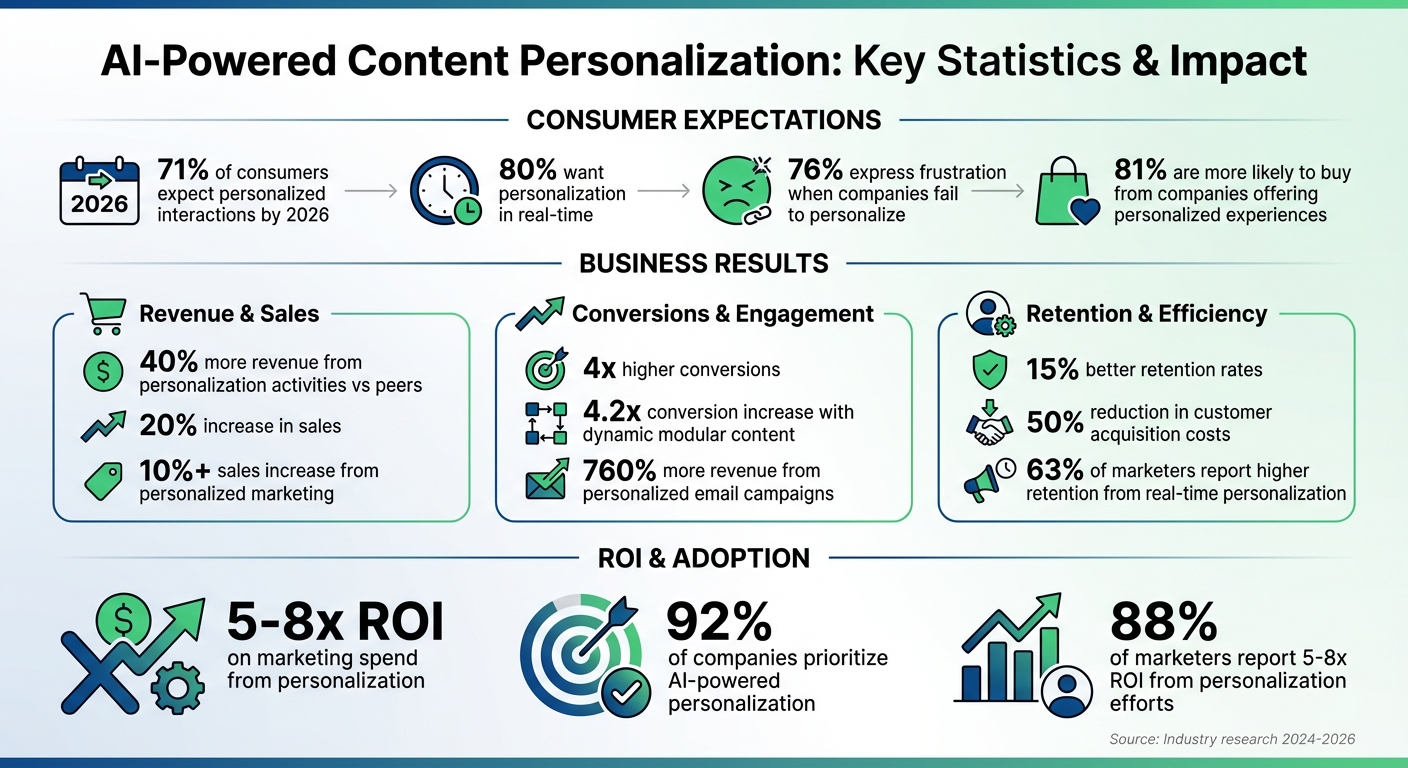
AI Content Personalization Statistics and ROI Impact 2024-2026
Personalization at scale goes beyond simply addressing customers by their first name in an email. It’s about tailoring content, offers, and experiences to each individual customer across millions of profiles and various channels - all in real time [7][9]. This approach delivers unique pages, recommendations, and messages that align with each person’s behavior and intent.
In the past, personalization relied on broad segmentation for specific channels. Now, AI-driven personalization introduces "micro-segmentation", where every visitor is treated as a segment of one [8][10]. Instead of relying on manually created rules for every scenario, AI uses machine learning to analyze behavioral patterns and create personalized experiences instantly. This shift represents a major leap in customization, harnessing the full power of AI.
Esat Artug, Senior Product Marketing Manager at Contentful, explains the philosophy behind this approach:
"Personalization at scale is not just a marketing strategy but a philosophy that focuses on delivering tailored, meaningful, and relevant customer experiences" [9].
To achieve this, businesses must unify customer data across all touchpoints - web, mobile, email, and even connected devices - breaking down data silos in the process [7][9].
AI personalizes content by analyzing live data streams and predicting what each user might want or need next. Modern systems employ an "Intent Engine" that integrates clickstream data, a Customer Data Platform (CDP), and a Vector Database to interpret the meaning behind user behavior [1]. This enables AI to understand not just what a user clicked, but the reason behind their action.
A modular content architecture plays a critical role here. Businesses create libraries of reusable content components - like headlines, images, testimonials, and calls-to-action, all tagged with metadata. AI then assembles these "content LEGOs" into personalized combinations based on user behavior, referral source, and device type [4]. For first-time visitors, contextual clues such as location, time of day, and landing page help shape a tailored experience immediately [1].
A great example of this in action is Canva. In 2024, the design platform used AI to scale its weekly email volume from 30 million to 50 million messages. By automating content translation into over 20 languages and integrating dynamic recommendations, Canva saw a 33% increase in open rates and a 2.5% boost in engagement - all while maintaining a 99% deliverability rate [7].
These strategies form the backbone of personalization efforts that drive meaningful revenue growth.
The impact of personalization on revenue is clear and measurable. Companies that excel in personalization generate 40% more revenue from those activities compared to their peers [9]. High-performing organizations report that personalized marketing delivers five to eight times the ROI on marketing spend and increases sales by 10% or more [9][12].
The reason is simple: personalization removes barriers in the customer journey. When customers see content that speaks directly to their needs - whether through tailored product suggestions or perfectly timed emails - they’re far more likely to take action. In fact, 81% of consumers are more likely to buy from a company that offers personalized experiences [14]. Additionally, personalization can cut customer acquisition costs by up to 50% [11].
A standout example comes from Kayo Sports, an Australian streaming service. In fiscal year 2024, Kayo Sports used an AI-powered "Customer Cortex" engine to scale from 300 communication variations to 1.2 million personalized messages. This one-to-one marketing approach led to a 14% increase in subscriptions, an 8% rise in average annual occupancy, and a 105% jump in cross-sells [7]. The system continuously optimized which message, offer, and timing worked best for each subscriber through reinforcement learning.
The numbers speak volumes: 92% of companies now prioritize AI-powered personalization to stay competitive [13]. Moreover, 71% of consumers expect personalized interactions, and 80% demand real-time personalized content [4][6]. Businesses that fail to scale personalization risk falling behind, while platforms like Content Maker Studio enable the workflows needed to meet these expectations.
The move from broad customer segmentation to AI-driven personalization has introduced strategies that craft tailored experiences for each user. By combining real-time data analysis, modular content systems, and generative AI, businesses can deliver messages that resonate with users at the perfect moment, creating a scalable framework for personalization.
Traditional segmentation often relies on basic demographics. However, AI-powered micro-segmentation dives deeper, analyzing behavioral cues like browsing habits, purchase intent, and content interactions to anticipate individual needs [6]. This approach treats every user as a unique segment.
Modern systems use the Intent Engine Pattern, enabling predictive models to forecast actions like the next best offer, optimal email timing, or even customer lifetime value before a purchase happens [1][15]. This goes beyond tracking clicks - it uncovers the intent behind them.
For first-time visitors, AI doesn't wait to gather extensive data. Instead, it taps into contextual signals - such as referral sources, device information, or time of day - to personalize experiences right from the first interaction [1]. This "cold start" capability ensures personalization begins immediately.
The payoff is clear: 76% of users express frustration when companies fail to personalize experiences, while businesses with robust personalization strategies report up to a 20% increase in sales [15][6]. Personalized email campaigns, in particular, have shown to generate 760% more revenue compared to generic ones [2].
Once behavior prediction is in place, the next step involves delivering content that adapts to user actions in real time.
Real-time personalization adjusts content in milliseconds based on live triggers. AI can respond to events like cart abandonment, weather changes, location updates, or specific page views, tailoring emails, landing pages, and recommendations instantly [7].
AI uses modular content systems to create unique combinations for each visitor. For example, one user might see a message emphasizing cost savings, while another sees one highlighting speed - both drawn from the same content library.
Microsoft Ads found that advertisers using AI to dynamically assemble modular ad creatives achieved up to a 4.2x increase in conversions compared to static ads [4]. To execute this seamlessly, many companies now use "edge personalization", where AI operates at the CDN level through tools like Cloudflare Workers [1]. This eliminates delays or "content flicker" during page loads, ensuring fast, smooth performance. With 80% of consumers expecting real-time personalization and 63% of marketers attributing higher retention rates to it, the demand for this strategy is undeniable [6].
Generative AI takes personalization to the next level by creating entirely new content tailored to individual users. This includes personalized text, visuals, and even custom interface elements that adapt dynamically.
The foundation for success lies in high-quality, first-party data. AI models depend on clean inputs from CRM systems, web analytics, and transaction histories to avoid errors that could derail personalization efforts [15][5]. Once data is unified, generative AI can craft everything from email variations to product descriptions that align with each user’s preferences.
Tools like Adobe Firefly Services enable real-time creation of visual assets. For instance, banners can adapt to a user’s location, current weather, or recent browsing behavior [1]. This isn’t just about swapping images - it’s about designing a completely unique visual experience for every visitor.
The most advanced implementations include "Generative UI", where AI creates entire interface structures as needed [1]. For example, a customer initiating a return might see a personalized "Return Wizard" interface tailored to their specific order, which disappears after use. This represents the future of personalization: interfaces that exist only when required.
The results speak for themselves: personalized creative can deliver 4x higher conversions and a 15% boost in retention rates [5]. With 92% of businesses planning to invest in generative AI for personalization, it’s clear this technology is becoming essential for modern strategies [15].
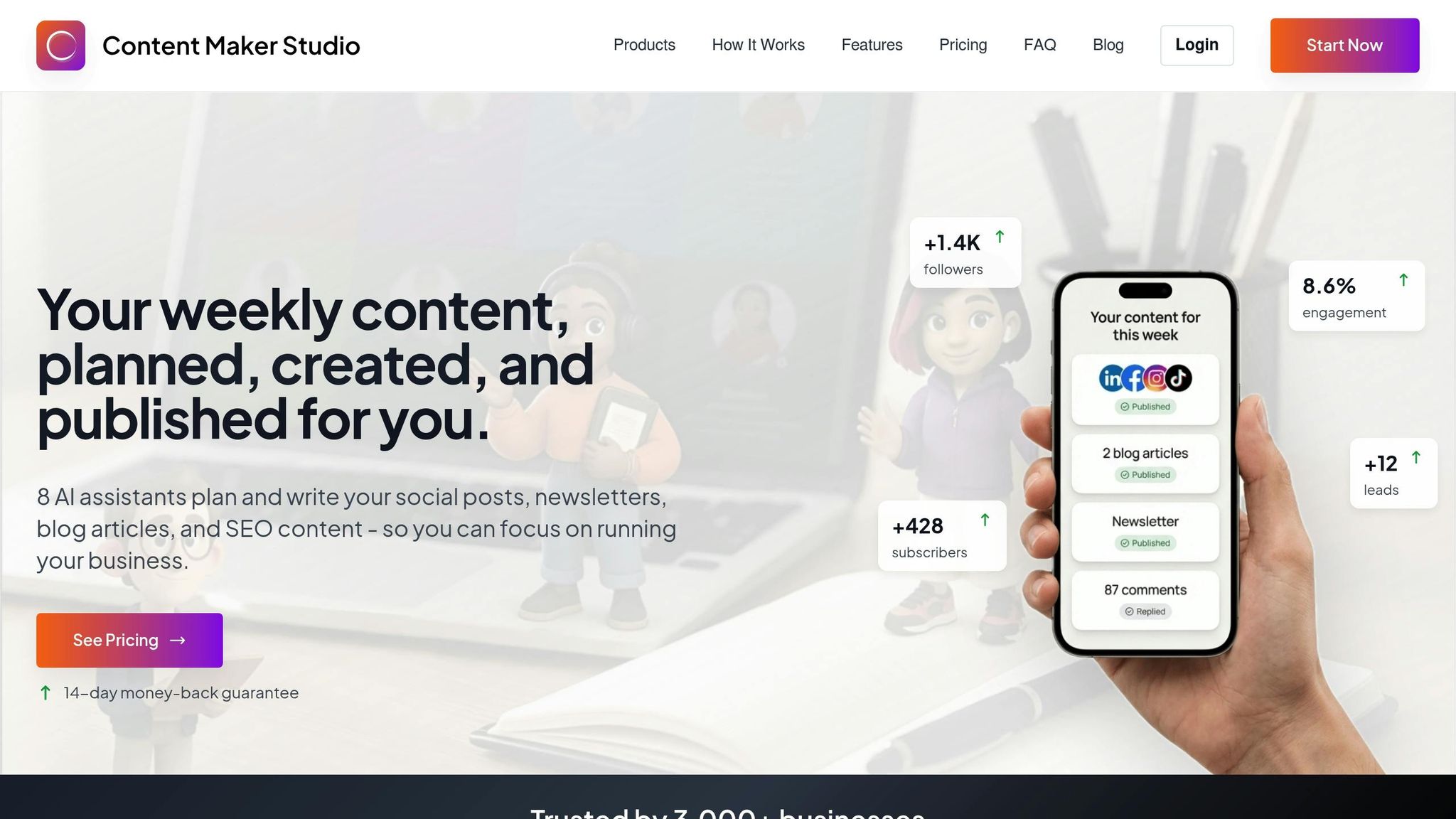
Scaling personalization effectively requires a system that connects audience insights, content creation, and performance tracking. Content Maker Studio makes this possible by combining 12 AI-powered assistants into a streamlined workflow. From research to optimization, this platform automates the personalization process, enabling teams to deliver true 1:1 experiences at scale.
With 71% of consumers expecting personalized interactions[4], Content Maker Studio steps in to handle repetitive tasks like content formatting, trend analysis, and reporting. This allows teams to focus on strategy while AI takes care of execution.
Creating personalized experiences starts by breaking down high-performing content into modular pieces - like headlines, CTAs, and visuals. Content Maker Studio’s AI assistants tag each piece with metadata (e.g., persona, industry, or funnel stage) to create a flexible content library[4].
The process begins with AI-driven audience research and trend analysis, which identifies industry patterns, content gaps, and common user questions[16]. These insights feed into the content planning assistant, which maps out topics aligned with user intent. Writing and design assistants then generate drafts and visuals, while SEO tools ensure the content is optimized for relevant searches[16].
The system’s real-time dynamic assembly tailors experiences instantly. For example, when a user visits your site, AI evaluates their behavior - such as referral source, browsing history, or device type - and assembles the most relevant content blocks into a unique experience. This approach drives better conversions, reflecting broader industry trends[4]. Finally, the performance analysis assistant tracks engagement metrics, offering insights for ongoing improvement.
By automating these steps, Content Maker Studio simplifies personalization workflows and makes them scalable for businesses of all sizes.
Content Maker Studio offers pricing plans designed to make these powerful personalization tools accessible to everyone. The platform eliminates entry barriers while unlocking all 12 AI-powered assistants.
| Plan Name | Price | Description/Tagline | Features | Limitations/Restrictions |
|---|---|---|---|---|
| Monthly Plan | $38.80/month | Affordable monthly access to all features | Includes all 12 AI assistants, unlimited content creation, integrations | None |
| Quarterly Plan | $70.80/quarter | Best value for consistent users | Includes all 12 AI assistants, unlimited content creation, integrations | None |
| 6-Months Plan | $99.00/6 months | Long-term savings for committed users | Includes all 12 AI assistants, unlimited content creation, integrations | None |
Each plan includes unlimited content creation, cross-platform integrations (LinkedIn, Instagram, TikTok), and multilingual support. These features are typically reserved for enterprise-level contracts, but Content Maker Studio offers them at a price point accessible to startups. With pricing in the $100–$300 per month range for entry-level AI tools, this platform provides affordability without sacrificing scalability[18]. Considering that 88% of marketers report a 5–8x ROI from personalization, this investment can quickly pay off through improved conversions and stronger customer retention[17].
To truly understand the impact of your personalization strategy, you need to measure its direct contribution to revenue and engagement. A key way to do this is by tracking incremental lift - the added revenue and engagement that personalization generates compared to a control group receiving generic content [19].
Your metrics should reflect both short-term successes and long-term value. For example, conversion uplift per segment shows how well your efforts resonate with different audiences, while Customer Lifetime Value (CLV) highlights whether you're cultivating lasting relationships or just boosting one-off sales [19]. Other useful indicators include engagement metrics like page dwell time and scroll depth, alongside revenue-focused metrics such as increases in average order value and revenue per user. Companies that excel in personalization see 40% higher revenue from these activities compared to their peers [19].
In addition to engagement and revenue metrics, consider operational metrics like content reuse rate and time-to-market reduction, which reflect how efficiently you're managing your personalization efforts [4].
Traditional last-touch attribution models often fall short because they fail to capture the complexity of multi-touch customer journeys. Instead, adopting data-driven or algorithmic attribution models can help you assign credit more accurately across all touchpoints [19].
These metrics not only help you measure current success but also provide a roadmap for refining your strategy.
AI plays a crucial role in creating a feedback loop that continuously improves personalization efforts [19]. Machine learning algorithms analyze user behavior - such as clicks, dwell time, and scrolling patterns - to predict the best next step for each individual [3][15].
A/B/n testing is another powerful tool, allowing AI to test multiple content variations simultaneously. This helps identify the top-performing headlines, images, and calls to action quickly [4]. For example, tools like Content Maker Studio’s performance analysis assistant track these metrics and integrate insights directly into your content planning process. By setting a minimum 95% confidence threshold for revenue metrics and 90% for engagement metrics, you ensure that only statistically reliable improvements are scaled [3].
With 88% of marketers reporting a 5–8x ROI from personalization efforts [15], this data-driven, iterative approach ensures your strategy consistently delivers measurable results.
Delivering one-to-one personalized experiences has become more than just a competitive edge - it's now an expectation. With 76% of consumers expressing frustration when personalization falls short [23], businesses that treat it as optional risk being left behind. By 2026, the leaders will be those leveraging modular content architectures where AI dynamically assembles tailored experiences in real time, rather than relying on manually crafted variations for broad audience segments.
Right now, three major trends are reshaping how personalization works. First, hyper-personalization is taking personalization to the next level by using tools like vector databases and behavioral signals to predict individual intent, moving far beyond static audience segments [1]. Second, predictive offers are changing the game by using advanced timing models to deliver promotions exactly when customers are most likely to act, instead of sticking to marketer-driven schedules [21]. Finally, multimodal content creation is enabling the instant delivery of customized images, videos, and interfaces. As we've seen, advertisers using AI-generated creative have reported impressive boosts in conversion rates [4].
"In 2026, the value will shift to targeting and selection - the ability to identify exactly which content, variant, or message should be delivered in each moment." - Karl Rumelhart, CPO, Contentful [20]
Looking ahead, the technical infrastructure supporting personalization is just as important as the strategies themselves. With the end of third-party cookies and the retirement of Privacy Sandbox in 2025, first-party and zero-party data will become the backbone of effective personalization [1][22]. Platforms like Content Maker Studio are already stepping up, centralizing data from multiple AI tools to streamline scalable personalization workflows.
As the generative AI market is projected to surpass $80 billion by 2030 [4], success will depend on combining technical precision with messaging that feels genuine. Continuous A/B testing and feedback loops will be key, ensuring models stay aligned with real user behavior. This blend of strategy and technology is just the starting point - businesses that can evolve their personalization systems at the pace of changing consumer expectations will shape the future of AI-driven content.
To get started with AI personalization, you’ll need first-party data - this includes information like user behavior, preferences, demographics, and contextual signals. This type of data is gathered directly from interactions such as website visits, app usage, or purchase histories. As third-party cookies become a thing of the past, it’s crucial to shift your focus to creating a consent-based data system. Tools like Customer Data Platforms (CDPs) can help streamline this process. The key is ensuring your data is clean and high-quality so AI can generate accurate, personalized content effectively and at scale.
To provide real-time personalization without compromising your site's speed, focus on efficient user behavior tracking and AI technologies designed for speed. Use a combination of scalable AI decision engines, modular content libraries, and first-party data to deliver fast, tailored experiences. By fine-tuning decision-making processes and utilizing cloud infrastructure, you can ensure your site stays responsive while achieving personalization in under 100 milliseconds.
To truly understand the ROI of personalization, it’s all about measuring incremental lift - the extra value your personalized efforts generate over generic content. Start by setting a baseline, then evaluate key metrics like revenue, customer lifetime value (CLV), or cost savings. Conduct experiments or compare results before and after implementing personalization to get clear numbers. Keeping an eye on conversion rates, engagement levels, and customer satisfaction will help you connect your personalization strategies to measurable business results.